The complete guide
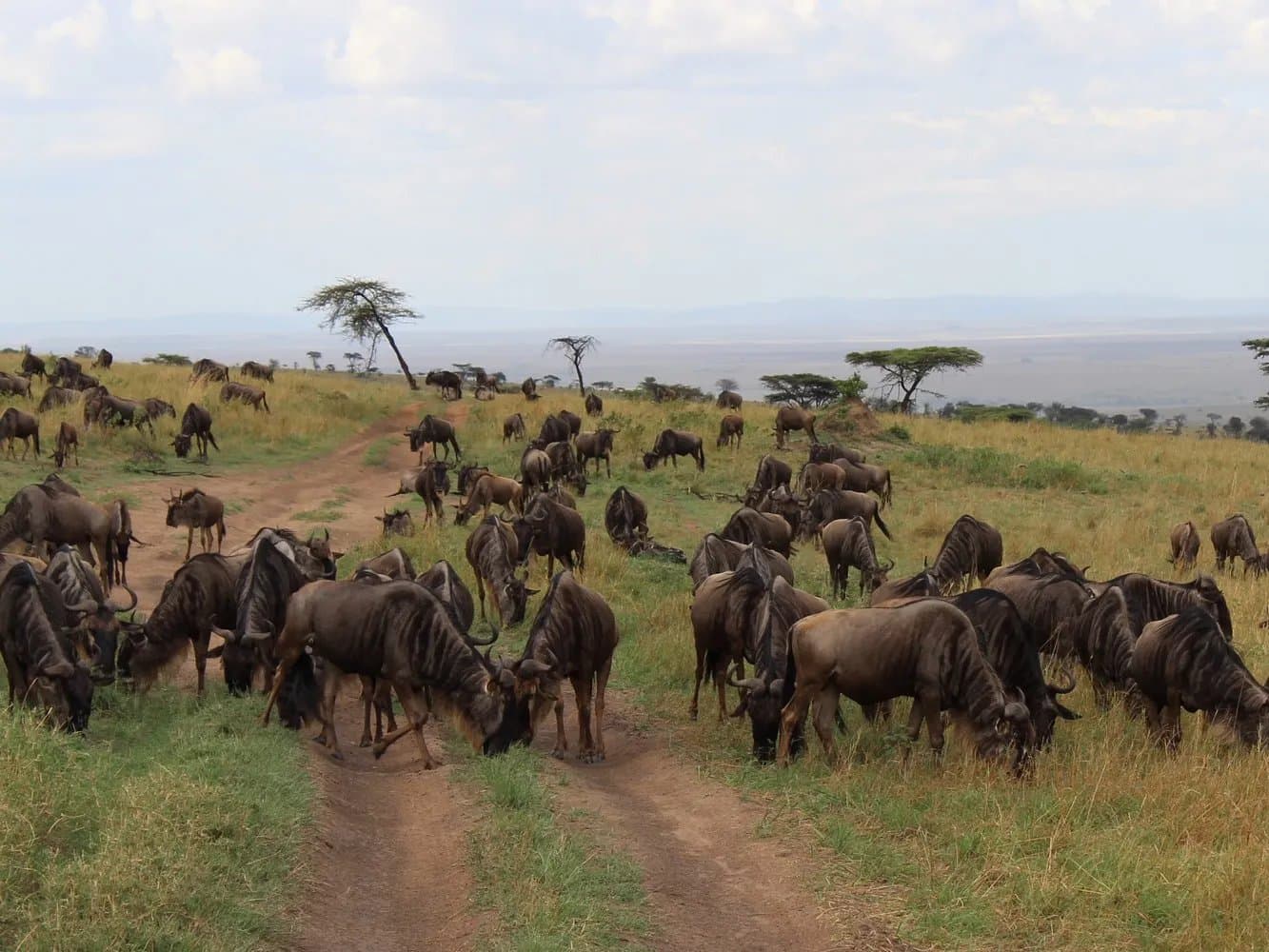
You hear it before you see it. A low, continuous grunting — hundreds of thousands of voices layered over each other — rolling across the plain like weather. Then you crest a rise and the grass itself seems to move: wildebeest to the horizon in every direction, walking with the strange, single-minded purpose of animals following something older than memory.
The Great Migration is the largest overland animal movement on Earth — over 1.5 million wildebeest, joined by hundreds of thousands of zebra and gazelle, circling the Serengeti-Mara ecosystem in a loop that never ends. There is no start date and no finish line. The herds are always somewhere, and the entire craft of a migration safari comes down to one thing: being in the right part of the ecosystem in the week you're there.
This guide covers how the migration actually works, the two headline events — calving and the river crossings — and how to plan a trip around a spectacle that famously refuses to follow a schedule.
What Exactly Is a Great Migration Safari?
A migration safari is a game drive safari with one organizing principle: the itinerary is built around where the herds are, not around a fixed circuit of parks. Instead of spreading your nights evenly across the Northern Parks, you concentrate them in the section of the Serengeti the migration is passing through — the southern plains around Ndutu in the calving months, the Western Corridor as the herds push north, or the northern Serengeti when they mass against the Mara River.
Because the herds move, camps that follow them move too. Mobile camps relocate two or three times a year to stay close to the action, and a good migration itinerary often mixes one of these with a permanent lodge — the mobile camp for proximity, the lodge for comfort.
Why This Is Worth Building a Whole Trip Around
Scale you cannot photograph. Every first-timer says a version of the same thing: the pictures didn't prepare them. A single frame holds a few thousand animals; the experience is standing inside a system of over a million, stretching past the curve of the earth.
Predator density follows the herds. Lion, cheetah, hyena and leopard concentrate wherever the wildebeest are. A migration safari is, quietly, one of the best predator safaris you can do — especially during calving, when hunts happen in open view almost daily.
It's two completely different spectacles. Calving season (roughly late January to March) and the river crossings (roughly July to October) are so distinct that many travelers come back to see the other one. One is green, concentrated and explosive with new life; the other is dusty, tense and dramatic.
When to Go
The honest answer: it depends entirely on which chapter of the story you want to see. The herds move in a broadly predictable annual loop, but the exact timing shifts with the rains each year — sometimes by weeks.
Late January to March — calving season, southern Serengeti and Ndutu. Hundreds of thousands of calves are born within a few short weeks on the short-grass plains. The predator action is the most intense of the entire year, the landscape is green, and the light is superb. The tradeoff: afternoon rain showers are common, and this is high season around Ndutu.
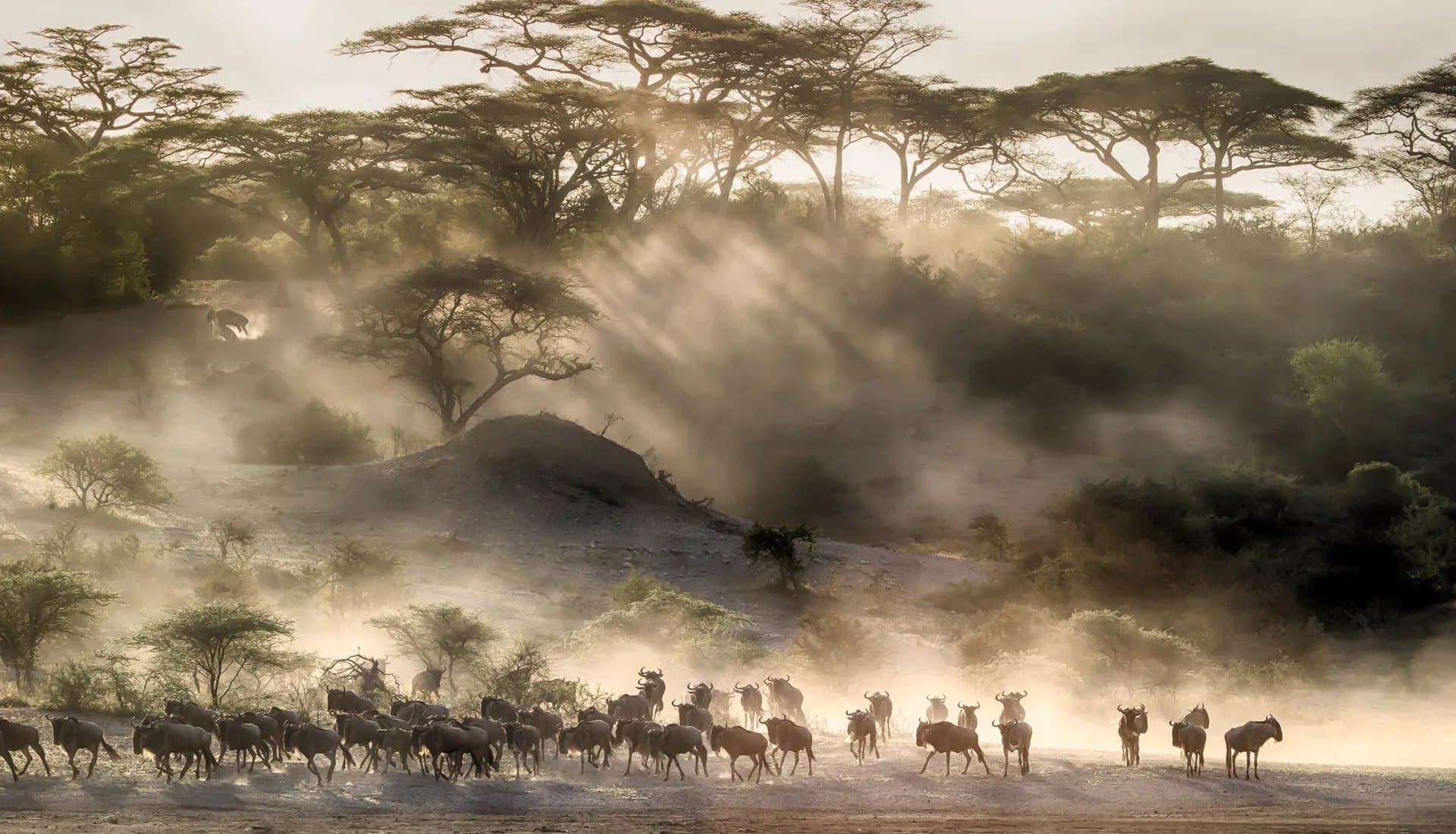
July to October — river crossing season, northern Serengeti and Masai Mara. The images everyone knows: herds massing on the banks of the Mara River, crocodiles waiting, the sudden chaotic plunge. Crossings are genuinely unforgettable — and genuinely unpredictable. Herds can cross three times in a day or wait a week. Patience, and a guide with a good radio network, matter more than anything else.
The in-between months are not dead time. April to June sees enormous columns on the move through the central and western Serengeti (with low-season prices and few vehicles), and November to December catches the herds streaming back south on the short rains. If crowd-free wildlife matters more to you than a single headline event, these windows are quietly excellent.
What a Typical Day Actually Looks Like
The rhythm is the classic safari day — dawn start, long morning drive, midday rest, afternoon drive — with one important difference: on crossing days, the schedule bends completely around the river.
5:30 AM
First light on the plains
Out of camp before sunrise. During calving, this is when the overnight hunts are still playing out.
7:00 AM
Find the herds
Your guide reads tracks, listens to the radio network, and positions you where the columns are moving.
Late morning
The waiting game
In crossing season, herds build up at the riverbank. You park, switch off, and wait — sometimes minutes, sometimes hours.
Afternoon
Follow the action
Crossings, predator activity at the edges of the herd, and the slow-motion drama of a million animals grazing their way north.
Sunset
Back to camp
At a mobile camp, the grunting of the herds often continues around the tents all night.
What It Costs, and What Drives the Price
Migration-focused itineraries start from $4,100 per person for 8 days tracking the northern crossings and run to $5,509 per person for 9 days built around the southern calving grounds — with fly-in versions that trade road transfers for bush flights sitting in a similar range.
- ›Season and location — camps in the northern Serengeti during crossing season command the highest rates of the year, and book out furthest in advance.
- ›Mobile camps vs lodges — mobile camps positioned on the migration route cost more than equivalent permanent properties further away. You are paying for proximity.
- ›Flying vs driving — bush flights into Kogatende or Ndutu save half a day each way and cost more; overland keeps the price down and adds landscape.
- ›Duration — the migration rewards time. Two or three nights in the right area beats a rushed single night, especially in crossing season.
What's included
- Park entrance fees
- Private guide & 4x4 vehicle
- All meals on safari
- Accommodation as specified
Not included
- International flights
- Visa fees
- Tips & gratuities
- Travel insurance
What to Pack
The standard safari kit applies — neutral clothing, hat, sunscreen, rain jacket — with two migration-specific additions: the best binoculars you can get your hands on (herd action often unfolds at distance) and serious dust protection for cameras during the dry crossing months. In calving season, add a warm layer; mornings on the short-grass plains are genuinely cold.
Photo gallery
What our guests say
“EWA Safari Outfitters gave us the most incredible experience of our lives. Our guide Samuel knew exactly where to find the leopard we'd been hoping to see — and delivered it on our last morning. Every detail was perfect. We'll be back for Kilimanjaro!”
Sarah & Michael Thompson — 7-Day Serengeti & Ngorongoro
“I've done safaris in Kenya and South Africa, but Tanzania with EWA Safari Outfitters was on another level. No crowds, no cookie-cutter experiences — pure, authentic wilderness. The balloon over the Serengeti at sunrise was life-changing.”
James Kowalski — 10-Day Northern Circuit
Frequently asked questions
Can you guarantee I will see a river crossing?
No honest operator will guarantee a crossing — the herds cross when they cross. What we can do is maximize your odds: multiple nights near the river in peak weeks, a guide plugged into the sightings network, and the flexibility to wait at the bank when a build-up starts. Most guests who spend three nights in the northern Serengeti in season see at least one crossing.
Which is better — calving season or the river crossings?
They are different trips. Calving is concentrated, green and predator-rich, with the herds packed onto the southern plains. Crossings are more dramatic but less predictable, with more waiting involved. First-timers who want intensity per hour often prefer calving; travelers chasing the iconic image want the river.
Where exactly are the herds each month?
Broadly: southern Serengeti and Ndutu from December to March, moving through the central and western Serengeti April to June, northern Serengeti and Masai Mara July to October, and streaming back south in November. The exact timing shifts with the rains every year, which is why we confirm the plan close to travel.
Do I need a mobile camp, or will a lodge do?
Either can work. Mobile camps sit closest to the herds and move with them; permanent lodges offer more comfort and better value but may mean longer drives to the action. Many of our migration itineraries mix one of each.
Is the migration only in Tanzania?
About 80% of the annual loop happens on the Tanzanian side of the ecosystem. The herds typically occupy Kenya's Masai Mara from roughly August to October, and river crossings happen on both sides of the border. A Tanzania-based itinerary can cover every phase except the Mara-side dry season peak.
Can I combine the migration with other experiences?
Easily. A hot air balloon flight over the herds is the classic add-on, and Zanzibar, Ngorongoro Crater and Tarangire all combine naturally with a migration itinerary.
What is the best month to see the Great Migration?
For river crossings, August and September in the northern Serengeti are the statistical peak; for the calving spectacle, February in Ndutu is unbeatable. Every month has the herds somewhere — the right answer depends on which chapter you want.
How much does a Great Migration safari cost?
Our migration-focused itineraries run from $4,100 per person for 8 days at the northern crossings to $5,509 per person for 9 days around the southern calving grounds, including park fees, guiding, meals and accommodation.